Everyone is a Scientist: Embracing My Curious Mind
I am an entirely accidental scientist.
Or so I thought.
I grew up enamored by saving earth worms after the rain, watching for tornadoes on the weather channel, and “playing around too much” by dissecting food and pens and flower petals whenever I got the chance. I got the nickname “terminator” in my house because I would often tear things apart to see the function of their internal structure. One day, I would rediscover this habit was a skill in systems thinking and university lab dissections.
When it came to school, I was a socially anxious kid overcoming a speech impediment, afraid to speak up for myself in class. Despite progress in the early 2000s and increased encouragement, many girls were and continue to be subversively discouraged from the sciences.
Over time, my outward confidence and passion for science pulled more and more inward, particularly when seeing how few girls were in robotics class, playing chess after school, or going to math team tournaments.
Despite my love of science, one of the subconscious lessons I struggled with at that time was, “If you can’t keep up with the boys, you should probably just stay quiet.”
Science quickly became my least favorite subject. I remember dreading words like “chemistry,” “biology,” and most of all, “lab” on my school schedule. When I went to college, I knew it would please my family to try for engineering, but one look at the course requirements of over 100 credits of science and endless repetition of the dreaded word “lab,” I went running to the humanities.
Funny enough, I come from a family of scientists in many forms: engineers, farmers, an accountant, cooks, doctors and nurses. They’re also freedom fighters, people who use the words “school of hard knocks” and “cómete tu miedo” (eat your fear), and a bloodline chock full of women who paved their own way. So suffice it to say, this attitude wasn’t gonna fly for long. Eventually, I’d find that my Caribbean, Nordic, and Midwest roots would tie a love for cultural diversity to a love for biodiversity and ecosystems. I would later learn there’s a scientific field of study that combines them–Political ecology!
II. Look for the Helpers
"When I was a boy and I would see scary things in the news, my mother would say to me, 'Look for the helpers. You will always find people who are helping.' To this day, especially in times of disaster, I remember my mother’s words, and I am always comforted by realizing that there are still so many helpers—so many caring people in this world."
- Mr. Rogers
Being Gen-Z, we were the first generation to grow up with constant access to social media and globalized, handheld news. I witnessed primary-source accounts posting in real time on the Syrian refugee crisis, the Ebola pandemic, the Black Lives Matter Movement built after the murder of Michael Brown Jr. in Ferguson, and more.
Between witnessing these crises and my own families living in highly disaster-prone regions of the Caribbean and Rural Midwest, I felt strongly called to serve communities in disaster and crisis.
One day, the CEO of a local refugee organization came to my high school and laid out the facts that typically get left out of the headlines. He told us: “most displaced persons will never leave a refugee camp or settlement,” and “It’s often only considered a ‘refugee crisis’ once it reaches the west. In reality, these crises are interconnected, worldwide, and constant.”
Something else he mentioned piqued my interest in this work. The organization was tasked alongside multiple governments and NGOs to create a refugee settlement city for upwards of 200,000. From the ground up, they needed to build schools, hospitals, housing, water and sewage systems, and all the infrastructure needed to serve the incoming families.
Immediately, I went up to him with a sheepish, “What degree should I get if I want to do that?”
I ended up pursuing urban planning at first and working in community organizing for a few years. In school, I became passionate about disaster response through geography and geo-tech courses, while also looking to my roots in courses on Latin American, Caribbean, and African history. SubhanAllah. I understood that the fields of social service and hard science were seemingly complicated when siloed but more comprehensive when brought together.
During the disaster of COVID-19 and counter-crisis of police brutality, I took two years off college. I worked as a pharmacy technician, just like my Abuelita who worked as a pharmacist in the Dominican Republic. This time of low staff and high need showed me that public service, business, policy, and science often overlap in critical ways on the ground. Healthcare was a catalyst transition where I realized that I had a long-hidden love for science and didn’t have to compromise it to serve communities in need.
I eventually transferred to Loyola University. Here, I had an amazing meeting with my future research advisor and our only Latina faculty, and her work convinced me that science maybe was my destiny all along.
Under Dr. Marlene Brito-Milan, I learned the concepts political ecology (how human politics and cultural influences impact ecosystems and vice-versa), solidarity science (working with communities to collect data for their needs and autonomy over their own data), and Indigenous data sovereignty (the right of Indigenous communities over information collected on their lands and on their traditional environmental knowledge, TEK).
From these frameworks and a classical training of environmental science, I researched Caribbean climate solutions at grassroots levels, from and for local communities, after receiving the Obama Voyager Scholarship for public service excellence. The Caribbean communities I visited had diverse locals-first solutions that proved local action can implement shareable solutions and global change. Local efforts included a nonprofit run by disabled leaders in Antigua and Barbuda mapping the entire island’s disabled community members’ needs in case of disaster; community centers in Puerto Rico decentralizing the microgrid and creating opportunities for women in green fields; and a marine conservation organization on the southern coast of the DR building coral reef labs and locals-led education programs; and more.
I now work in climate on a multitude of fronts, still holding onto that dream of working in disaster response full time, and a belief throughout every project that our own local and frontline communities are the primary-source scientists.
Everyday people around the world have all the solutions we need to combat the climate crisis.
Video from Bayahibe, República Dominicana (Dominican Republic) of mangroves along the southern coast - a natural climate solution to decreasing impacts of hurricanes & increasing biodiversity of endangered aquatic populations:
III. Electron Spheres, Neuroplasticity, Food Webs, and Phylogenetic Trees
Hardly anything in nature is straightforward or static. Even in scientific theory, including these four once very differently taught scientific core concepts, have been rewritten for their complexity.
Sometimes, there are parts of us that are complex in nature, that take years to label and years further to truly grasp.
The term “stealth dyslexia” applies to someone who goes undiagnosed for years—even up to a PhD without diagnosis. My diagnosis at 25 explained why, despite my love for learning, I would cry over textbooks at the kitchen table, getting stuck reading the same paragraph for multiple hours. This is the case for many youth with dyslexia whose passions for learning are stifled by unseen barriers.
Most people think of dyslexia as a visual problem, but it’s actually a cognitive processing issue. When you read, or for others, calculate math, your brain processes the information out-of-sequence. Dyslexia itself is experienced differently by each individual, but there are pattern types which dyslexics often have combinations of.
Oftentimes, people who go undiagnosed display signs early. Early indicators of my dyslexia included that speech impediment, difficulty with phonology (recalling what is associated with the words I’m reading), and flipping letters, words, lefts and rights. Like most dyslexics, I used a multitude of strategies to get by and unintentionally went under the radar of most of the adults around me. I can write and read aloud well enough to go mostly undetected but cannot comprehend texts or read with the endurance of my peer level. In my early years of college, I got a “W” or Withdrawal in nearly every heavy-reading literature course. Eventually, I learned about readaloud software, which allowed me to complete my bachelor’s in Environmental Science
The truth is, dyslexia doesn’t make your intelligence better or worse, but it does make how you think different from most.
Some of the greatest minds have been dyslexic: Mohammad Ali, Octavia Spencer, Ansel Adams, Steven Spielberg, Agatha Christie, Albert Einstein—one of the most famous scientists of all time—and more!
Once I understood that dyslexia was a cognitive processing disorder—not literally the Bella Thorne Disney short with letters and shapes moving in the air—I found it extremely emotional. I wondered what school and life could have been like if I’d known this sooner. I was afraid to talk to anyone about it or get help because of the shame I carried—of all the ways I fell behind in school, coming from an immigrant background where even dyslexia isn’t allowed to be an excuse, and worrying this diagnosis would hurt more than help my professional career.
After further education and support, a lot clicked within my story. It finally made sense that scientific texts were an incredible struggle for me. With the level of scientific verbiage and vocabulary, it was likely my dyslexia and not my lack of love for the essence of science itself. Like most atypical traits, dyslexia is an advantage as much as it can be a handicap.
Science belongs to no one institution, ability, culture, gender, subject, or even species. It is in our nature to be scientists. If someone has ever made an observation and asked a question based on it, they’re a scientist!
In college, I read a comic in my ecology lab called Science Under the Scope by Sophie Wang. She shows how scientists are not flawlessly objective, floating robots, try as we might. In an innovative way, the comic explains how the subjective backgrounds and fiscal motives behind researchers largely influence how science gets taught and from whose perspective.
Allah (SWT) Alone, as I taught my Sunday school garden class students this spring, is Al-Alim, the All-Knowing. In a lecture on science from a Qur’anic perspective, Dr. Seyyed Hossein Nasr describes Al-Alim as the Great Scientist, the only One to have knowledge in pure, objective form.
In this way, science belongs to everyone.
Anyone who has scrunched up a napkin to fix the load balance of a wobbly table.
A child observing for the first time how shadows work on sidewalks and from where the sun rises.
Grandmas innovating the chemistry of cooking over generations, healing flus and preserving food science.
Trees, which “talk” to each other by sending signals through fungal and chemical mycorrhizal networks.
Sedimentary rock, which has preserved fossils for hundreds of millions of years.
Toothed whales using echolocation, evolved from hunting in the deep ocean.
As I taught my students this spring, during our soil science & the name of Al-Alim class::
“Raise your hand if you’ve asked a question today…”
Half their hands raised
“Raise your hand if you’ve observed something…”
All their hands raised
“If your hand is raised you’re a scientist!”
And then came a chorus of, “Yayyyy!” & one very special, “Alhamdulilah!”
Alhamdulilah for all of the science around and within us; for Al-Alim, who made us all scientists in His Perfect Design.
Surah Ar-Rum 30:22
And of His signs is the creation of the heavens and the earth, and the diversity of your languages and your colors. Indeed in that are signs for those of knowledge.
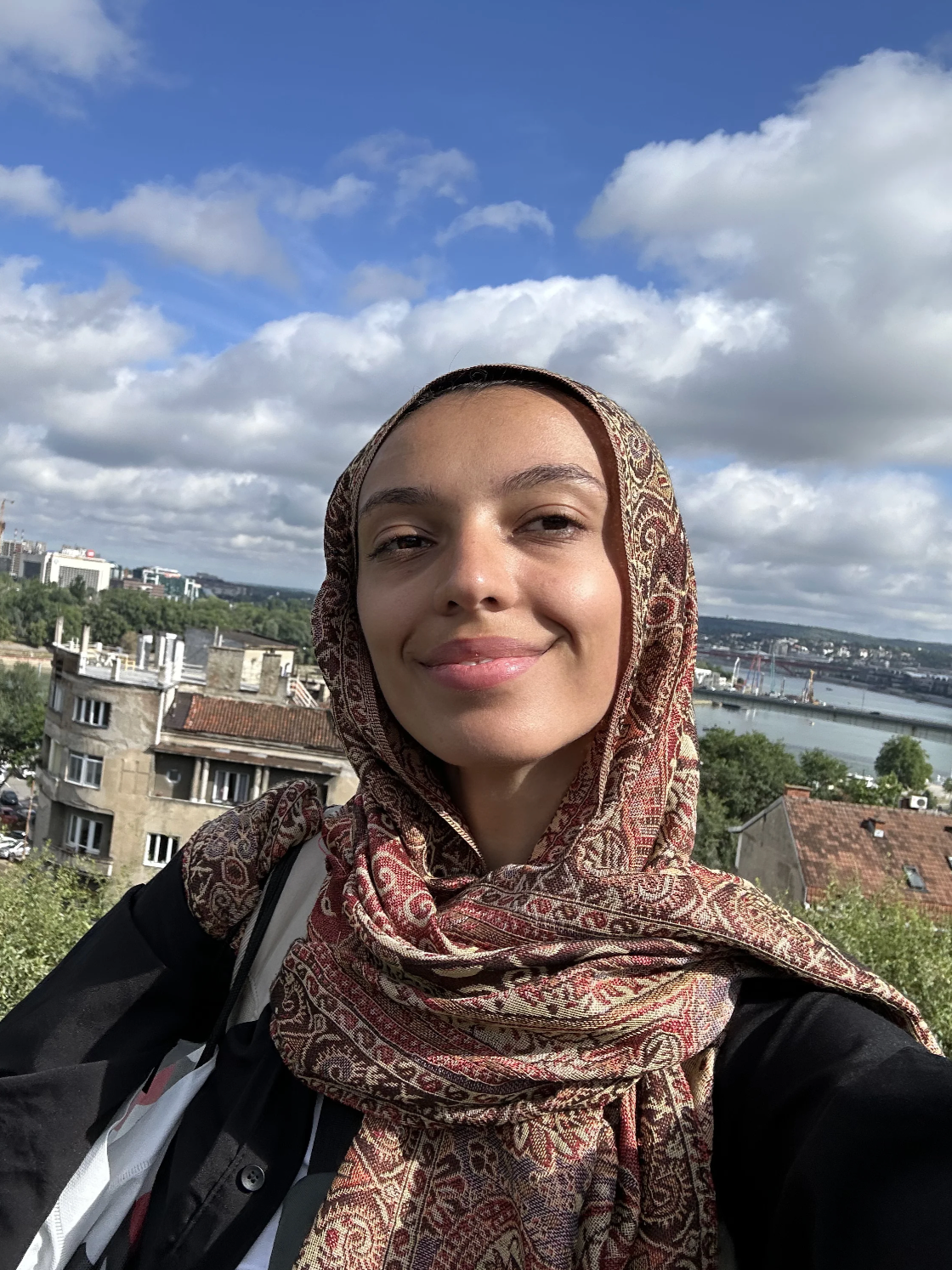
Ruth is an environmental scientist and community organizer currently based in Minnesota. Her work focuses on social impact, climate science, and crisis response. Her Caribbean-Midwest roots drive her global heart and community-centric mindset. Ruth’s 6-word leadership story is “We need every story and everyone.” She is an Obama-Chesky Public Service Excellence Voyager scholar, Loyola Johnson Gender Justice Research Scholar, and Abrams Sustainable Business Challenge finalist. She had her start in community organizing and civil rights work in the Twin Ports with the NAACP, women’s rights and gender-based violence advocacy, and arts civic engagement for youth. After the pandemic, she worked in healthcare where she learned how policy impacts people, companies, and systems face-to-face. Her research has focused on community-driven climate solutions from across the coasts of Caribbean islands to the Midwestern Great Lakes and across the world to Egypt’s Sinai region. Since college, she has worked with Restore America’s Estuaries on the Great Lakes Restoration Initiative Community-Driven Grant Program (GLRI-CGP), the Obama Foundation, and a Muslim women’s community center/academic institute. She has volunteered with her local Masjid’s Sunday school, Minnesota Voluntary Organizations Active in Disaster (MNVOAD) and the Red Cross.