
From Malcolm X to ICE: Echoes from Earlier Generations on Resistance
The afternoon of the first general strike in Minnesota since 1934, I stood on the back of a truck. It was January 23rd, and people from across the state of Minnesota poured into the streets of downtown Minneapolis.
There were tens of thousands of us. We were there because we were angry, because we had enough of ICE kidnapping our neighbors. Because we were sick of watching masked men and women harass and intimidate our communities. For several blocks we marched. All of us in the below zero wind, cold blistering our cheekbones and numbing our toes; cold clumping our eyelashes and nosehairs together with thin layers of frost and ice.
Indigenous community members guided the march from the ground with their drumming and intergenerational dance. Union organizers, prominent civil and human rights leaders, immigration rights organizers, clergy, and impacted community members made fiery speeches from the truck. In between speeches, Teiko drummers wove steady rhythms through the crowd’s echoed chants, the combination like an exclamation point after every speaker.
I had been brought to speak as a member of Minnesota Labor for Palestine, a grassroots coalition of union and non-union members based in working class solidarity with Palestine. Minnesota Labor for Palestine was one of many endorsing groups that served on the organizing committee for the strike, which was primarily organized by unions and immigrant rights organizations. When it was my turn to speak, I knew I wanted to say something that spoke towards hopefulness, towards victory, because this was not the first time the people of the United States have resisted authoritarianism.
As an African American Muslim whose grandparents fled the Jim Crow South, I think often of the conditions that have led to this moment. Those conditions have always intersected with and are inextricably connected to anti-facist, anti-authoritarian, anti-colonial and anti-imperialist movements domestically and abroad. My favorite historic example of this can be found in a 1951 petition submitted to the United Nations, entitled We Charge Genocide.
We Charge Genocide is 250 pages, a book-length record of the United States’s genocide against Black Americans. The petition puts the United States government on trial, estimating that between 1946-1951, 32,000 Black Americans died each year because of this structual genocide. The petition included statistics and evidence-based analysis, and it leveraged the U.N.’s recently approved ratification of the Geneva Convention, which made acts of genocide punishable under international law following the atrocities of both the Holocaust and the Nekba. We Charge Genocide pointed to the hypocrisy of the United States, which, following these atrocities, had positioned itself as a global leader to step in to take control of the crumbling reign of the imperial powers of Europe and West Asia.
The petition was a radical call to action directed at international communities. It drew a clear red line that had been repeatedly crossed and made comparisons between Nazi Germany and the Jim Crow South. In addition to the mass slaughtering of Black Americans, We Charge Genocide detailed the many ways in which “economic genocide” and organized terror campaigns by groups like the KKK accelerated this structual violence. The petition made an argument demonstrating that if left un-checked, localized human rights violations and authoritarianism at home undoubtedly would lead to facism and world wars globally.
The petitioners wrote in their opening statement, “The responsibility of being the first in history to charge the government of the United States of America with the crime of genocide is not one your petitioners take lightly. The responsibility is particularly grave when citizens must charge their own government with mass murder of its own nationals, with institutionalized oppression and persistent slaughter…”
Building upon previous efforts of Black-led civil rights groups and commissions to appeal to the U.N., We Charge Genocide was written in the summer 1951 by prominent leftist activist William L. Patterson, who co-led the Civil Rights Congress (CRC) with internationally renowned actor/singer and activist Paul Robeson. The petition lit a spark in Black American resistance circles.
The United States government made its apprehension of the petition known. American politicians and mainstream media attempted to draw attention away from the petition. Propaganda against the petition circulated nationally, and the signatories were systematically demonized and retaliated against. Because some of the signatories, including Robeson, were socialists, both the federal government and segregationists made ample use of “red scare” propaganda to silence the efforts of the petition’s signatories. Despite these tactics, We Charge Genocide garnered attention within anti-facist, anti-colonial, and leftist movements domestically and internationally.
Ultimately, the outcomes of the petition did not create conditions for the abuses of the United States government to be held accountable internationally, but it did have several indirect victories. Shifting the international narrative that the United States projected globally, it established a bridge from leftist and anti-imperialist communities across Europe, Africa, and East and West Asia to Black Americans. It also left a lasting impact on the ideological values of Black resistance movements that followed in the United States.
Nearly a decade later, on April 27th, 1962, Black Muslim men carrying laundry from a Los Angeles mosque were brutally attacked and shot at by the L.A. police department. This attack resulted in several unarmed Black Muslim men being permanently disabled. Ronald Stokes, a leader in the L.A. Black Muslim community was shot in the heart. The police cuffed Stokes after murdering him and beat his dead body for several minutes. Malcolm X, who by then had already established himself as national leader, flew to California to support L.A.’s Black Muslim congregation. It was there that Malcolm spoke his often quoted but rarely contextualized words during a rally for Stokes: “ …who taught you to hate the color of your skin?” and “The most disrespected person in America is the Black woman…” Leading up to that portion of this speech, Malcolm unpacked the structural violences of police brutality and drew attention to the multitude of ways state sanctioned violence terrorized Black communities both materially and psychologically.
Towards the end of his speech Malcolm highlighted the Islamophobic undertones of the L.A. police department. Malcolm described how the Black Muslim men, who were already shot and bleeding out on the pavement, held hands and chanted “Allahu Akbar,” and how the officers, in an effort to dehumanize the men, told mainstream media outlets that the chanting was a “death chant.” Malcolm concluded his speech with a call for unity between Black diasporic people and between people of color across the world. He urged oppressed people from all faith communities and backgrounds to join forces, to assert their human rights and build power against their shared oppressor.
A month after Malcolm’s speech, the Black Muslim newspaper Muhammed Speaks resurrected the We Charge Genocide petition, drawing a connection to Stokes and the many structual violences experienced by Black people in the United States. A June issue of the paper referenced the petition in an article entitled “We Charge Genocide.” The article included the U.N.’s definition of genocide and drew comparisons between what happened in L.A. to other global human rights violations.
There’s an argument to be made that many of the strategic responses and tactics propagated by the Black Muslim movement of the 1950s and 1960s were “answers” to the challenges outlined in the We Charge Genocide petition. Where the strategies of the civil rights movement focused on legislative transformations of systems and laws of inclusion into established institutions and structures, the initial strategies of the Black Muslim movement prioritized sovereignty through the creation of autonomous alternatives. In her book, A Nation Can Rise No Higher Than Its Women, Africana Studies professor Bayyinah Jeffries describes this phenomenon in great detail in a chapter devoted to the activism of Black Muslims.
To paraphrase Jeffries, while civil rights leaders organized sit-ins and demonstrations to integrate schools, the Black Muslim movement built their own schools and wrote their own textbooks. As civil rights leaders trained heroic freedom riders to construct a moral crisis in the public arena by not reacting to the violence of mobs who encircled lunch counters they attempted to integrate, the Black Muslim movement started businesses and in later decades of the movement, secured multimillion dollar trading deals from countries like Peru and Libya to invest in Black Muslim owned business so as to drastically reduce the unemployment and hunger crisis of Black communities.
The strategies and tactics of both the civil rights movement and the Black Muslim movement were necessary to materially change the conditions of Black people in the United States. These Black Freedom Struggle movements required both the nonviolent direct actions of the civil rights movement and the liberatory power cultivated from the Black power and Black consciousness of early 20th century Black Muslim movements and their secular predecessors and descendants. They were all necessary pillars of resistance. They also had a ripple effect that improved the overall human rights conditions for all marginalized communities in the United States. This is not to say that these different strategic approaches were not at times, at odds or never conflicted with each other. They did, a fair amount. However, an equally important truth is how these differing tactics and strategies intersected, overlapped, and influenced each other—and how they continue to influence current resistance movements.
The arrival of contemporary movements such as Black Lives Matter or American pro-Palestine solidarity movements can’t emerge without these foundational strategies and lessons from both civil rights activists and the 20th century Black Muslim and Black power movements. In North Minneapolis, when Black youth and Black Muslim women from my masjid occupied the 4th precinct after the Murder of Jamar Clarke in 2015, I saw how the occupation and protests were in direct dialogue with the 1967 rebellion that took place on the very same street. In 2024, I saw how the occupation of the University of Minnesota’s Morrill Hall by students within the pro-Palestine solidarity movement echoed a 1969 occupation of the very same building by 70 Black student organizers who demanded meaningful change following the assassination of Dr. Martin Luther King Jr.
I also see the echoes of these movements showing up in the Anti-ICE resistance movements of today. When rapid responders show up within minutes to disrupt ICE raids, I think about Malcolm. How in 1957 he was able to mobilize 2,000 Black Muslim men and women trained in unarmed self-defense to a Harlem police precinct to demand medical treatment for a Black Muslim man who had his head cracked open by the NYPD. Malcolm was able to mobilize these retro-rapid responders because of a phone-tree system popularized by the Black Muslim movement which ensured its members could arrive on scene to defend themselves against state sanctioned brutality within minutes.
When I see our Muslim sisters join their neighbors across Minnesota to organize mutual aid or car pools to deliver groceries or to provide rides for our most impacted immigrant communities being targeted by ICE, I am reminded of the Montgomery Bus Boycott.
The boycott was sustained for more than a year, in part because of the mutual aid efforts of its organizers. They organized carpooling and support networks that undoubtedly made boycotting segregated buses an attainable, collective goal.
When Muslim women in the Somali community organize community patrols to defend themselves against ICE, I am reminded of the Black patrols of the 1960s.
In a recorded talk given at a University of Minnesota event in 2018, freedom fighter Spike Moss describes the racist violence of the era vividly. For 91 days the Black patrols defended Northsiders from armed white supremacists following the rebellion of 1967. Moss recalled how the police deliberately abandoned the thriving Black economic hub as a form of retaliation against the community for asserting their power as Black people. In the video, Moss describes the often minimized history of the overt racism and discrimination of Minneapolis. He highlighted that many of Black Minnesota’s rebellions have been erased from Minnesota history over the decades.
The morning after the first general strike, I thought about these courageous ancestors and elders who built the foundations of this fight. I hadn’t slept and I wouldn’t sleep for another 24 hours. Federal agents had escalated their attacks on our neighbors while we were striking. I was wearing my whistle, preparing to walk a neighborhood that upon initial glance, felt removed from the crisis.
It was a breathtakingly beautiful morning. Sunshine dosed itself everywhere and on everything. The air was bitterly cold, but still, the generous smile of the small business owner upon returning my salam warmed me. He refused to take my money when I tried to buy chai and invited me to sit for a while, to let my hands warm, as surah Ar-Rahman wafted in from some hidden speaker above us. The offering made me want to reciprocate each small reprieve of that fleeting moment: a smile for a smile. A warmed hand for a warmed hand. A mercy for a mercy.
Hours from that moment, someone will be kidnapped by federal agents in that neighborhood. In another neighborhood, perhaps at the same time, the calls and texts will circulate about a shooting. The man won’t survive. We will learn his name is Alex Pretti.
Some of us will rush to the scene to assert our humanity, to demand justice for Victor Manuel Díaz, for Keith Porter, for Renee Good, for Alex Pretti. Some of us will plan rallies and vigils to hold space for collective grief after the smoke of tear gas clears. Some of us will continue building networks of mutual aid and rapid response. Some of us will organize second and third strikes, and some of us will fly out to DC. Some of us will organize healing circles, teach-ins, self-defense trainings, direct actions, and workers assemblies. Some of us will build tipi outside of a former concentration camp. Some of us will never stop demanding the land be restored back to its Indigenous people. Some of us will never stop demanding a free Palestine, a free Sudan, a free Congo. Some of us will send letters and make phone calls and get arrested outside of airports and big department stores. Some of us will write poems. Some of us will recite them. Some of us will never never stop demanding reparations for the descendants of enslaved Africans who survived the middle passage. Some of us will go to meetings demanding a pause to evictions, and some of us will create unions. Some of us will make noise outside of hotels and sing at marches, and blow into brass horns. Some of us will dance. Some of us will build barricades. Some of us will do other things we can not name aloud here, and some of us will pray. Some of us will cry. Some of us will chuck back what was sent our way. Some of us will cuss out our oppressors. Some of us will never stop demanding an end to incarceration. Some of us will prepare a meal for a relative who hasn’t slept in days. Some of us will carry trays of sambusa to a protest. Some of us will never stop demanding an end to deportations, because no one is illegal on stolen land. Some of us will record. Some of us will chant Linda Davis’ name. Some of us will only buy food and clothing from the small businesses of our Somali, Latino, Afghan, and Hmong neighbors. Some of us will unite Black people. Some of us will start book clubs. Some of us will organize gardens. Some of us will organize political campaigns. Some of us will sketch portraits. Some of us will sleep. Some of us will never wake up. Some of us will wear our whistles outside of masjids, churches, and temples, outside of schools and daycares at pick-up and drop-off times. Some of us will hold our babies close. Some of us will wait outside a detention center to wrap a warm blanket across the shivering shoulders of a stranger.
And collectively, we will hold space for ourselves and for our neighbors, for the strangers we all once were, for the hours and days that follow, until the streets become ours again.
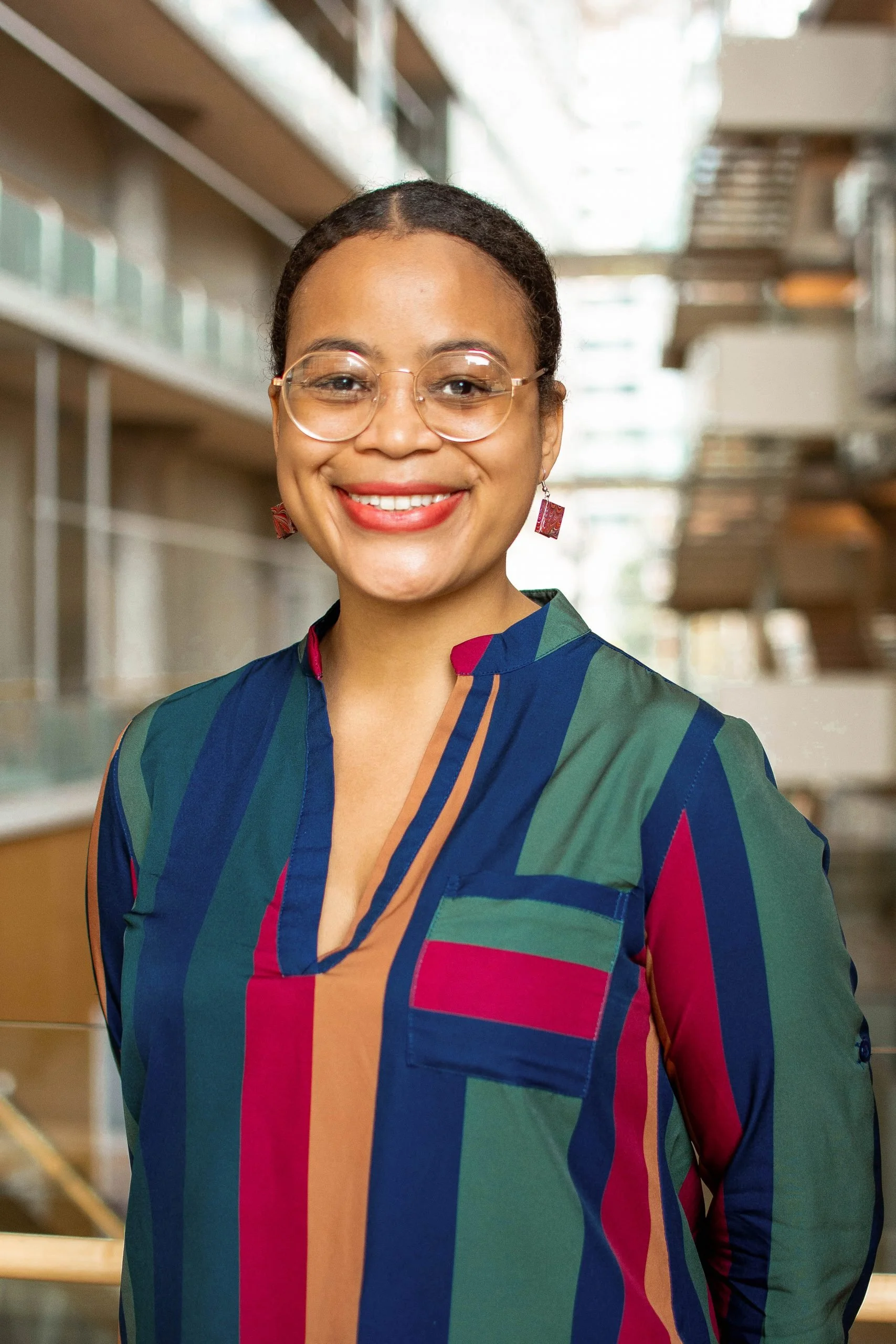
Sagirah Shahid is a Pushcart Prize nominated Black Muslim poet and performance artist from Minneapolis, Minnesota. Sagirah is a recipient of several awards, residencies, and fellowships, including from the Loft Literary Center, the Minnesota Center for Book Arts, Wisdom Ways, and the Twin Cities Media Alliance. In 2020, Sagirah was one of 23 artists selected by Muslim Advocates and the Shangri La Museum of Islamic Art, Culture & Design to be featured in the American Muslim Futures virtual exhibit. Sagirah's poetry and prose are published in Mizna, Winter Tangerine, Prose Online, KHÔRA, Juked, Paranoid Tree, Parhelion, About Place Journal, and elsewhere.